ROLE
Lead Instructor, UX Design Immersive
SCOPE
Iterated across 3 remote cohorts
Faced with disengagement and disconnection in a remote learning environment, I implemented strategies that fostered increased student engagement, stronger teamwork, and improved communication.
During the COVID-19 pandemic, the challenge of fostering connection in a fully remote UX Design Immersive (UXDI) program was addressed through collaborative work with students to establish shared values, the introduction of small group dynamics for consistent collaboration, and adjustments to communication tools that made room for spontaneity. These initiatives resulted in stronger teamwork and improved communication, outcomes that reflect a focus on empathy, adaptability, and collaborative problem solving as part of leading a classroom that no longer had a room.
When COVID-19 forced the shift to remote learning, the UX Design Immersive program faced an unprecedented challenge: how to maintain a sense of community when the classroom was reduced to a 13 inch screen. For students, every interaction felt like a performance. Being watched constantly, without the ability to become fully comfortable, increased self-consciousness. Many chose to disengage entirely, turning off their cameras in what became the ultimate disconnection. Students who kept their cameras off consistently made less effort to build community and form friendships, and it became easier for judgment toward others to creep in.
For instructors, the challenge was just as real. Before going online, I had relied on reading a room, on body language and the general mood of a class, to know when to adjust. Online, faces were small, eye contact was gone, and that read was nearly impossible to make. Nothing about the day felt spontaneous anymore. Every moment had to be planned, which meant every moment started to feel like ceremony instead of connection. The result was a widening gap between students and instructors, and a class that had lost its sense of unity before it ever really found one.
The lack of unity at the start of the remote program left each cohort in disarray. Overlapping schedules and inconsistent engagement standards only made the problem worse. To address it, I turned to a principle at the center of UX work itself: understanding user needs, in this case the needs of the students sitting in front of me.
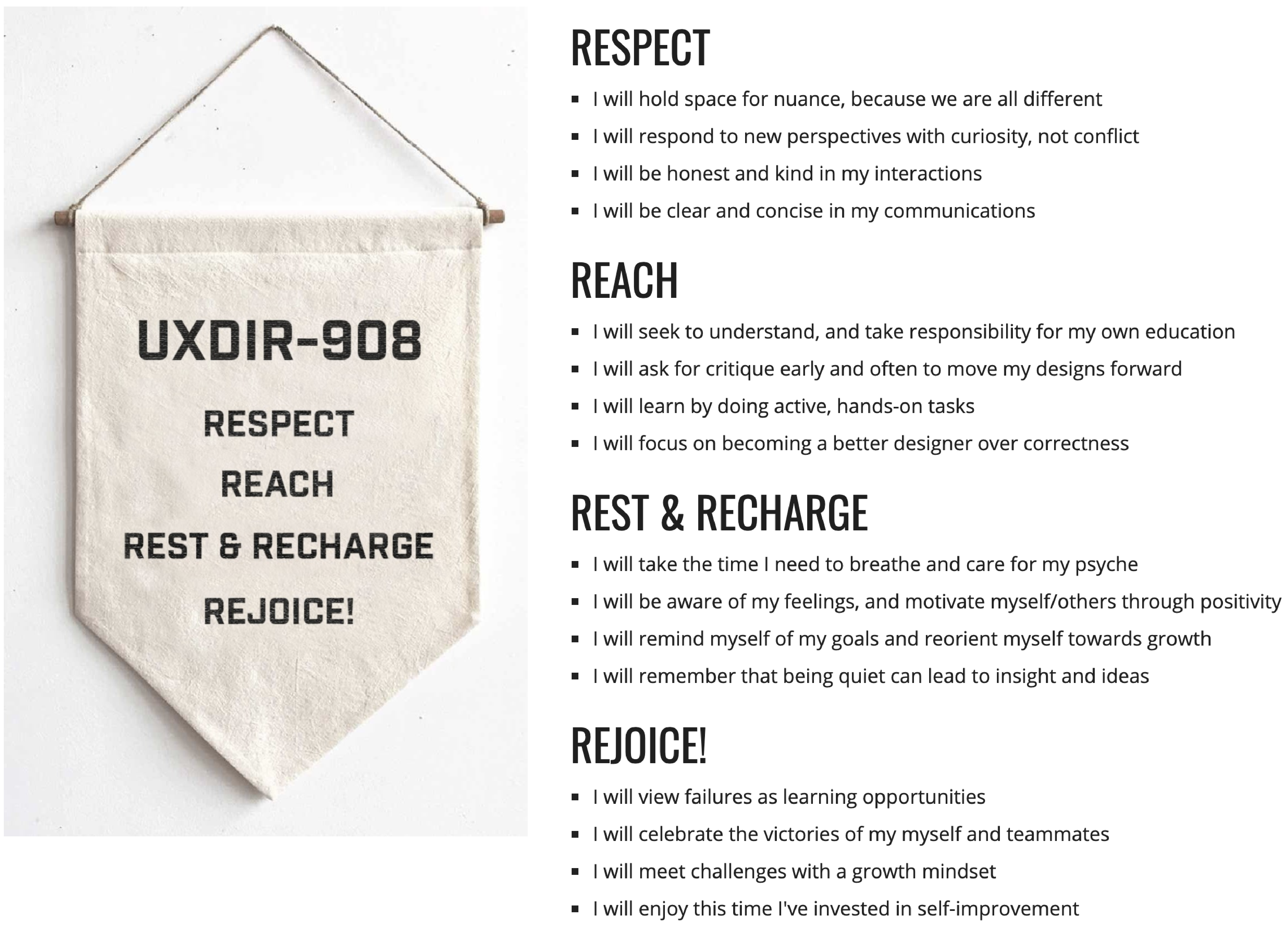
Using an affinity mapping exercise, I asked students to share their values and what they hoped to get out of this experience. Four core themes emerged from their responses, each backed by specific, self-authored commitments.
This charter became the class's guiding document, giving students a collective identity they had built themselves rather than one handed to them. It fostered mutual respect and accountability while creating a shared sense of purpose. As an instructor, building this charter with each cohort helped me see students as individuals with their own personalities and priorities, not just faces in a grid, and it deepened my connection to them in a way a syllabus never could have.
The tools we used for communication ended up creating barriers of their own. Slack, our channel for formal announcements, felt too rigid for anything spontaneous. Zoom's chat feature was initially disabled altogether, which meant there was no room left for the small, casual moments that used to happen constantly in a physical classroom. The result was a virtual space that felt sterile even when everyone was technically present.
To fix this, I re-enabled Zoom chat specifically for real time, ephemeral conversation, and kept Slack as the space for anything structured or persistent. Students used the chat to share jokes and commentary during lessons in real time. Because a message in the chat disappeared into the scroll rather than sitting permanently in a channel, it carried none of the weight of a formal post. There was no need to break away and open a different program just to say something funny or supportive.
We did have to rein it in a handful of times to keep the class on track, but this one small adjustment helped humanize a learning experience that had started to feel anything but human.
Large group dynamics are intimidating under the best of circumstances, and remote settings made that worse. Students often hesitated to share ideas or critique each other's work in front of the full class, which slowed everyone down and left little room for real connection. To counter that, I introduced consistent small groups, or tables, of four to five students that stayed together for the length of each project.
I made a habit of visiting these tables during critique sessions just to listen. The conversations happening there were personal and genuinely valuable in a way the full group rarely reached, largely because the group was small enough that everyone had to participate. One table in particular became remarkably efficient at giving each other kind, useful criticism, and other students started pointing to that group as an example of how a critique conversation should go.
By building these smaller, stable communities inside a much larger remote cohort, students had a consistent place to be honest with each other, to improve their work, and to build relationships that outlasted any single project.
Early on, the instructional team relied heavily on a private Teachers' Lounge, a separate virtual space where we could coordinate without students present. It made managing the workload easier, but it had a cost we didn't see right away: it made us feel unreachable. Students hesitated to reach out because doing so meant interrupting something happening behind a closed door.
Once that became clear, we made a simple change and stayed in the main Zoom room to be available for questions instead of retreating. That shift created a shared space where approaching us stopped feeling intimidating, because it was no longer someone else's space we were borrowing. Full tables would come out together to ask questions, which made it easier for everyone to hear the same answer at once. Some students simply stayed in the main room while working independently, which led to smaller, more trivial conversations along the way, the kind that build trust precisely because nothing important is riding on them. Staying present, even for the unimportant conversations, reinforced something students needed to feel: that we were part of the same team, genuinely invested in how they did, not administrators checking in from a distance.
Cohorts this approach interated across
Core values in the student built charter
Students per virtual critique "table"
Communication channels given distinct roles
While this is now a standard for much of the world, it was new territory for many in 2020. This experience taught me that a remote classroom does not have to feel disconnected by default. Through intentional design, across three cohorts of refinement, we built something that was not just functional but genuinely relational. Understanding what students actually needed, and being willing to balance structure with spontaneity rather than defaulting to one or the other, made room for belonging even inside a 13 inch window.
The lesson carried well beyond that classroom. Empathy and adaptability matter just as much in remote teaching as they do in UX design itself. Give people the right structure, and a sense of community can hold, no matter how far apart everyone happens to be sitting.


