ROLE
Research Principal, Workshop Facilitator
PARTICIPANTS
Sheriff's Department wellness team: sworn deputies and HR
I was part of a team designing a wellness app for people working in law enforcement, a field where the cumulative weight of the job shortens average life expectancy and where the culture, especially among more senior generations, treats asking for help as a sign of weakness rather than strength. The app paired a vitals monitoring wristwatch with discreet ways to request support and department facing resources meant to increase awareness and access without forcing anyone into the open.
That combination raised a question no one could skip past: this app would generate real, personal data about people doing an extraordinarily difficult job. Someone in leadership would be montioring a dashboard built from that data. For the app to mean anything, the people wearing the watch had to trust that the data would help them, not expose them. I led a focused workshop series with the department's wellness team, made up of sworn deputies, upper management, and HR, to work through that question directly, before a single dashboard screen was finalized.
I designed the series as a sequence of short, tightly timed exercises. Individual reflection came first, group synthesis came second, every time. That order was not about managing hesitation. It was about making sure every voice, including the quieter ones, made it onto the table before the conversation moved forward as a group.
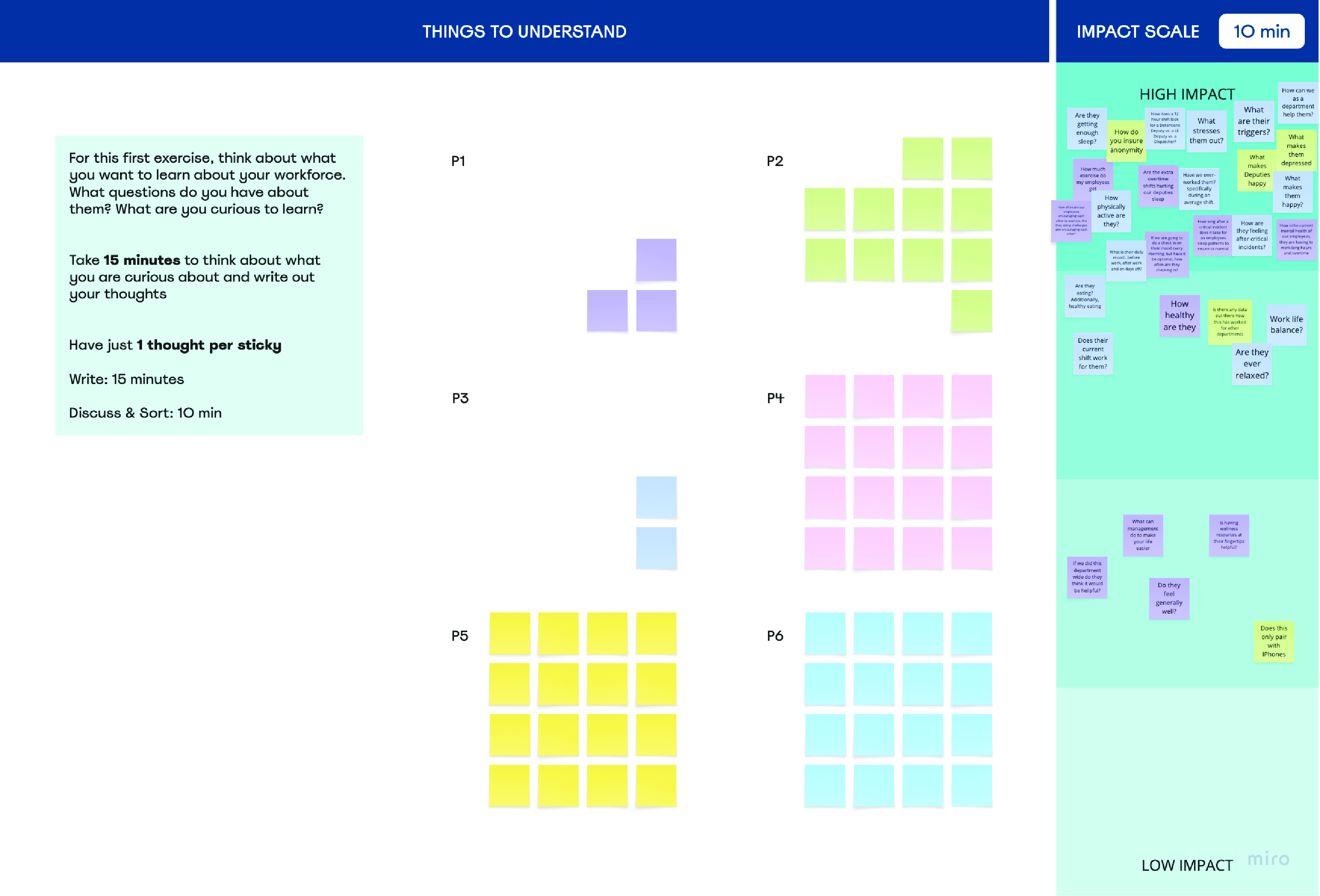
The first exercise asked each participant, working alone for fifteen minutes, to write down what they genuinely wanted to understand about their own workforce. One thought per sticky note, no pre filtering. We then spent ten minutes together sorting the full set onto a high impact to low impact scale.
What came back was specific and clearly born out of real care for the people they serve. Questions about how much overtime people were really working, whether shift patterns differed meaningfully between a Detentions Deputy, a patrol Deputy, and a Dispatcher, how sleep and mood held up after a critical incident, and how anonymity could actually be protected if any of this got measured at all.
Lower on the impact scale but still present were more operational questions, like what would make management's job easier and whether wellness resources at people's fingertips would actually help. The shape of the whole board told its own story. The team's deepest curiosity was not about optimizing management convenience. It was about genuinely understanding what their people carry.
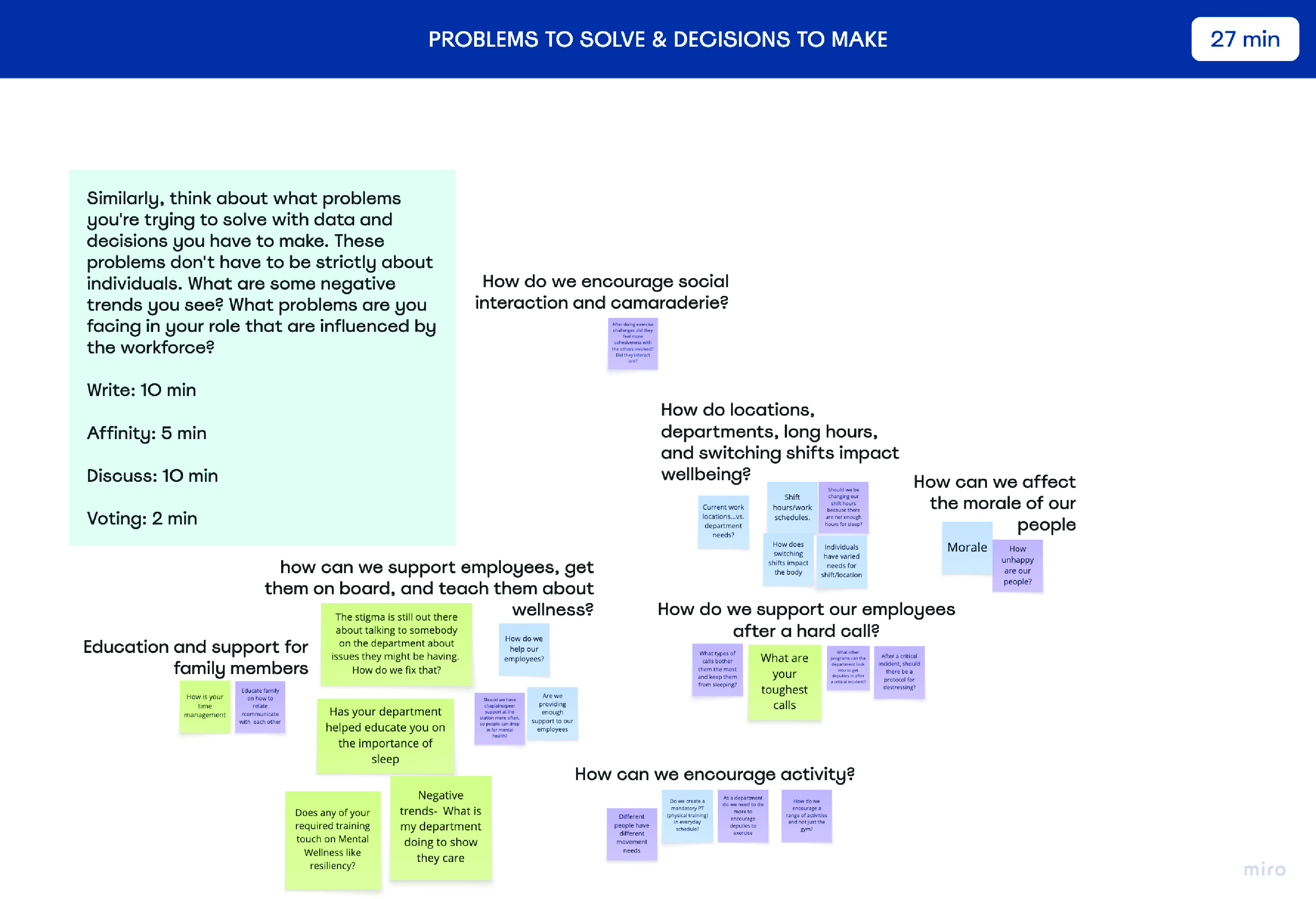
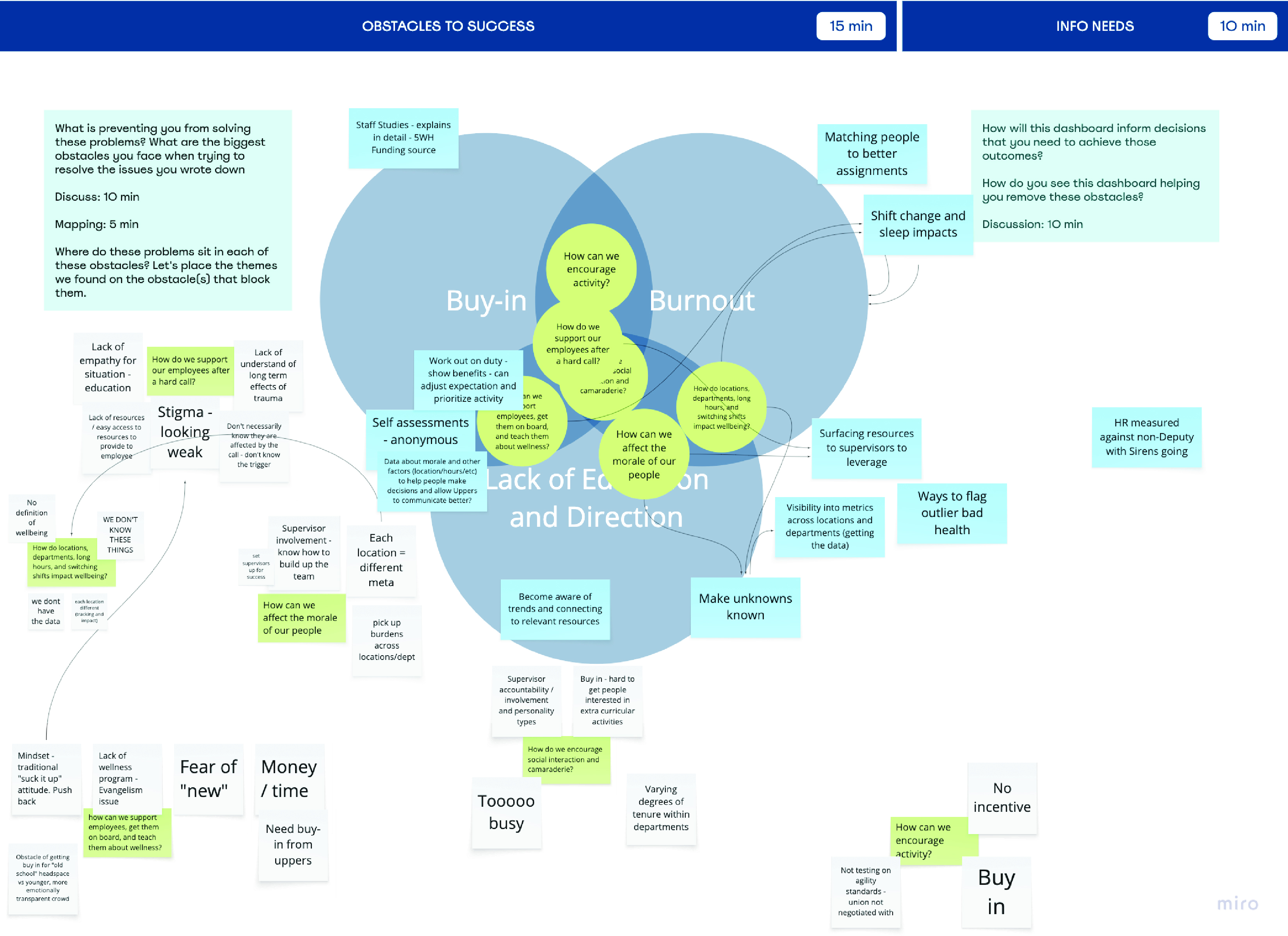
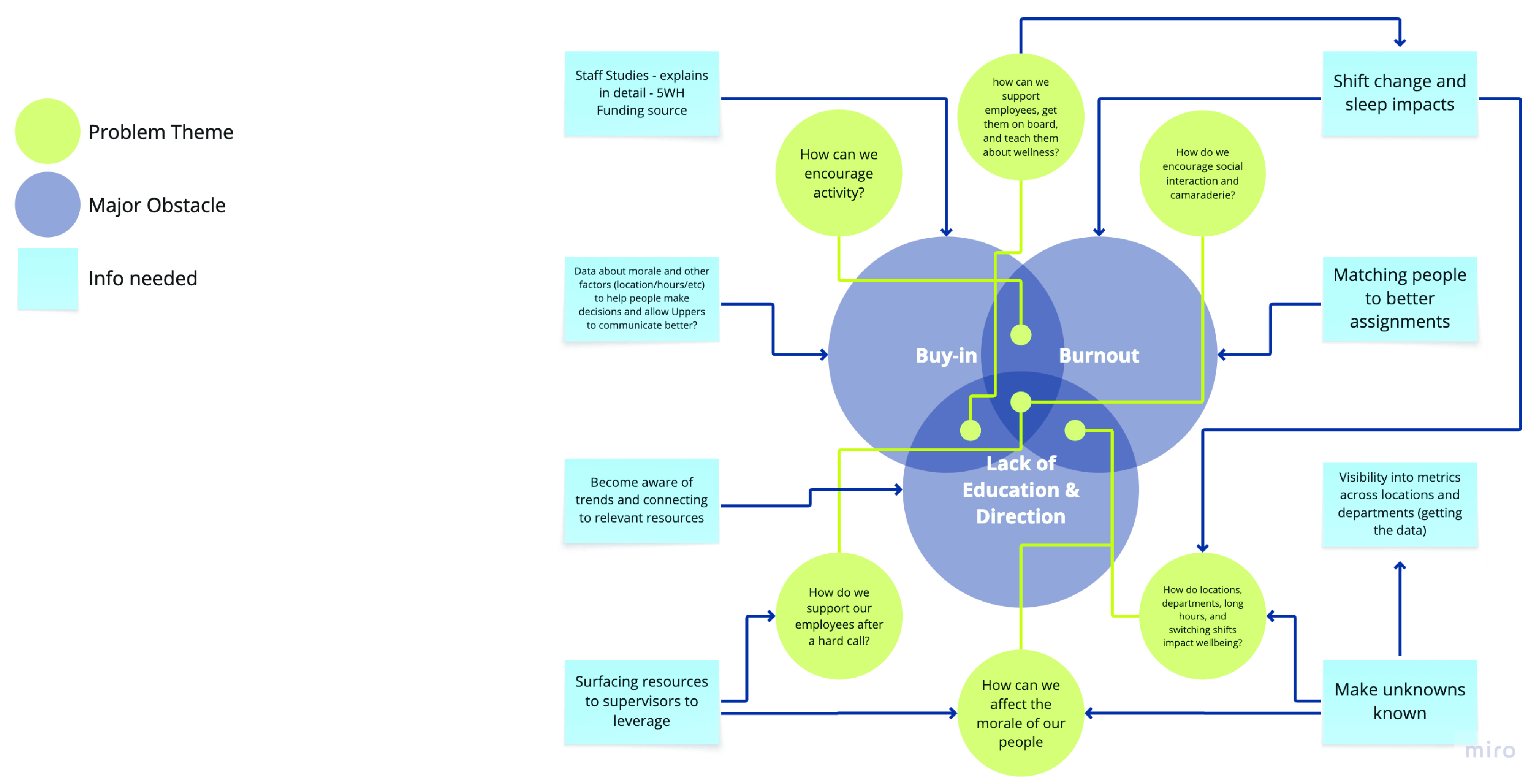
Rather than let the problem list stay a flat inventory, the next exercise asked the team to identify what was genuinely preventing them from solving these problems today, then map each theme onto the obstacle or obstacles blocking it. The room converged on three recurring, overlapping obstacles: Buy in, Burnout, and a Lack of Education and Direction.
The specificity of what came out under obstacles was the most valuable output of the entire series. Participants named a traditional "suck it up" mindset still pushing back against anything new. A lack of any shared definition of what wellbeing even meant across the department. An honest admission that the team did not yet have the data to know whether their own assumptions were correct.
Mapping those obstacles against a defined set of information needs, like surfacing resources to supervisors who could actually act on them, giving leadership visibility into trends across locations and departments without exposing individuals, and simply making unknowns known, gave the whole downstream dashboard effort a filter every later decision could be tested against. Does this address Buy in, Burnout, or the Education and Direction gap? If not, why build it first.
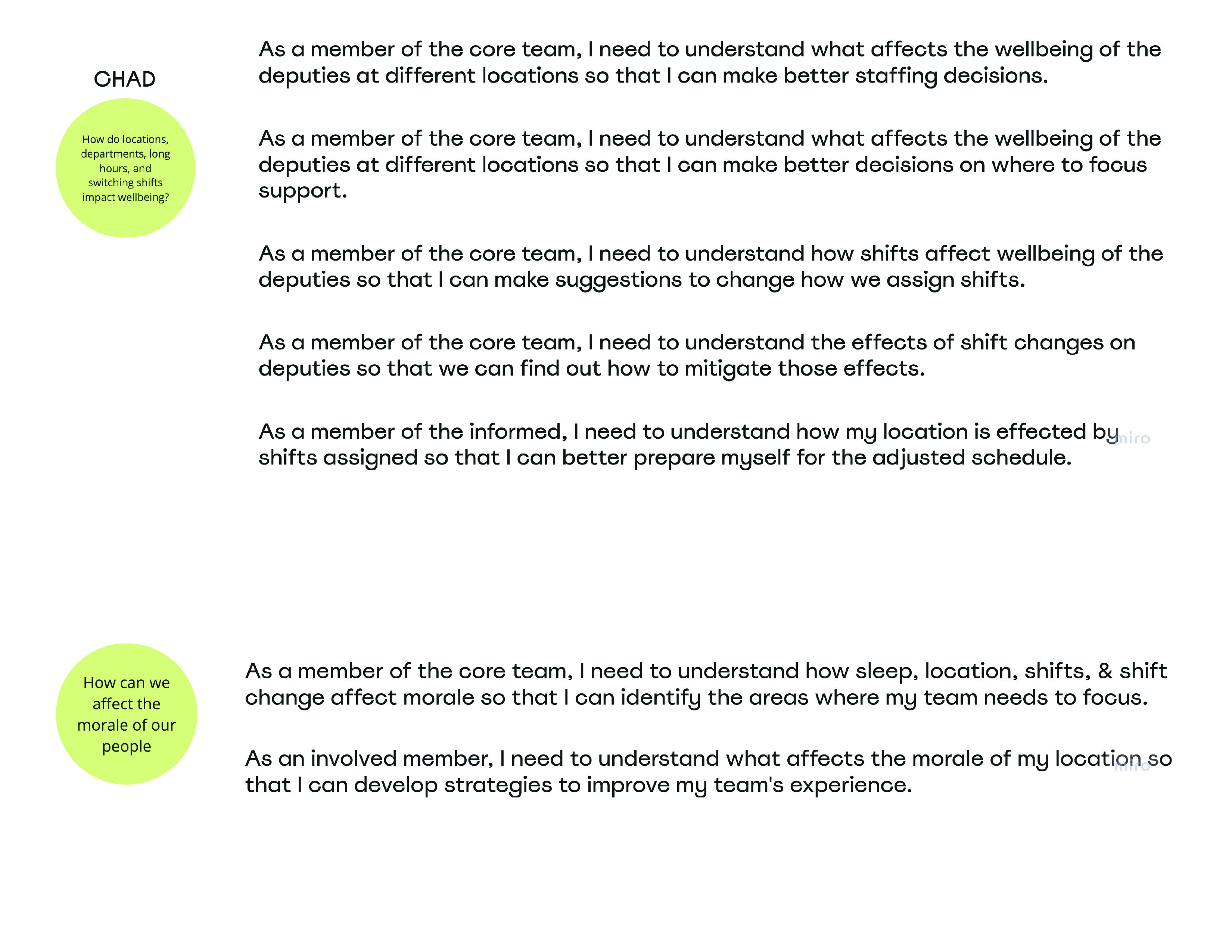
The next step was converting the highest impact questions and obstacle linked needs into formal user stories, structured as "As a _____ , I need to understand _____ so that I can _____". Each insight got a clear owner, a clear need, and a clear reason it mattered.
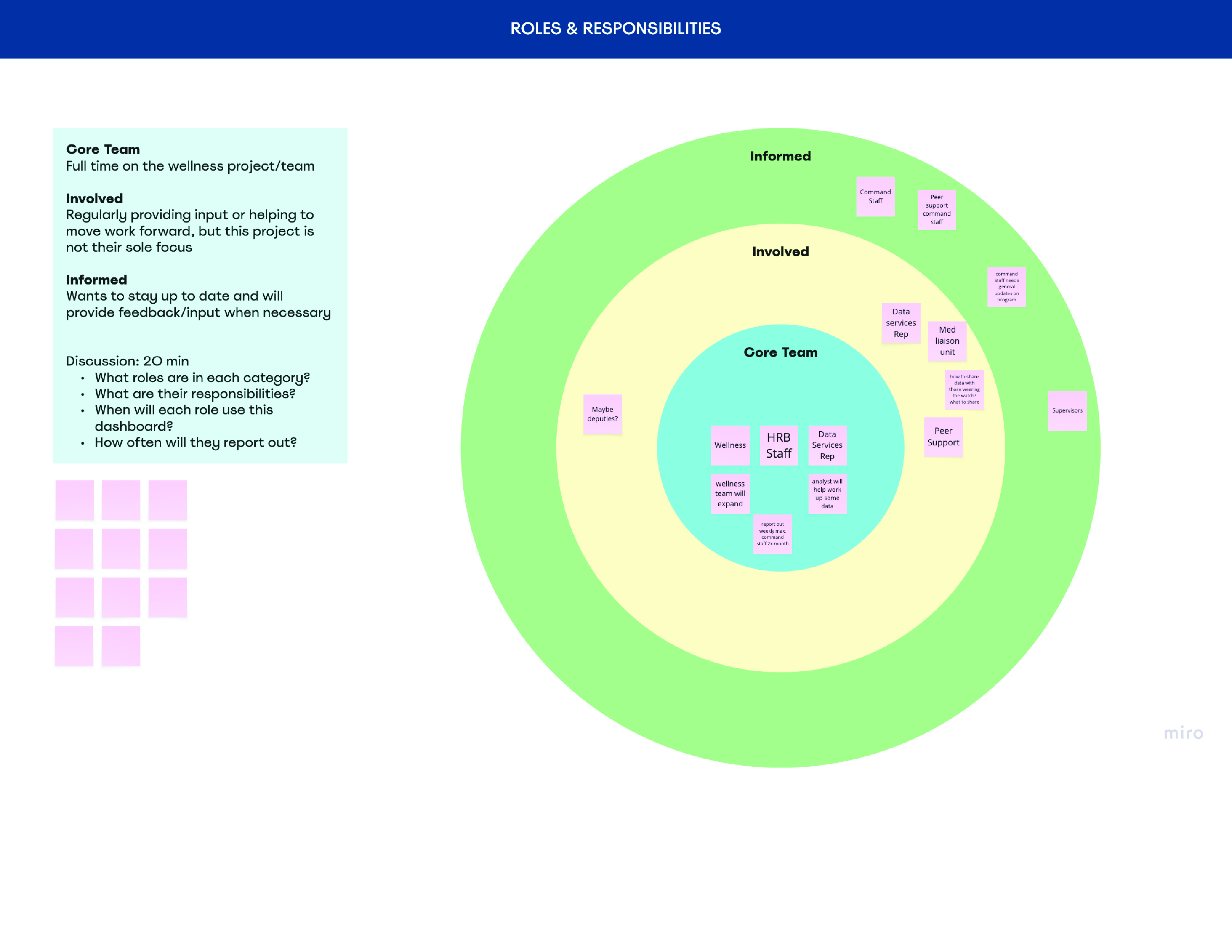
With problems, obstacles, and needs in hand, the series turned to one of its most consequential exercises: mapping exactly who should have access to what, using a Core Team, Involved, and Informed structure. The wellness team worked through each ring. Who was full time on this work, meaning Wellness staff, HR, and a dataservices representative. Who needed regular input without owning the work, meaning peer support, a medicalliaison unit, and command staff. Who simply needed to stay broadly aware, meaning supervisors and potentially deputies themselves.
The open questions the team surfaced while building this map were as valuable as the map itself. Most notably, the group raised its own question about how much data should be shared with the deputies wearing the watch, and what exactly that should include. That the wellness team asked this of themselves, unprompted, said a great deal about how seriously they were taking the responsibility in front of them.
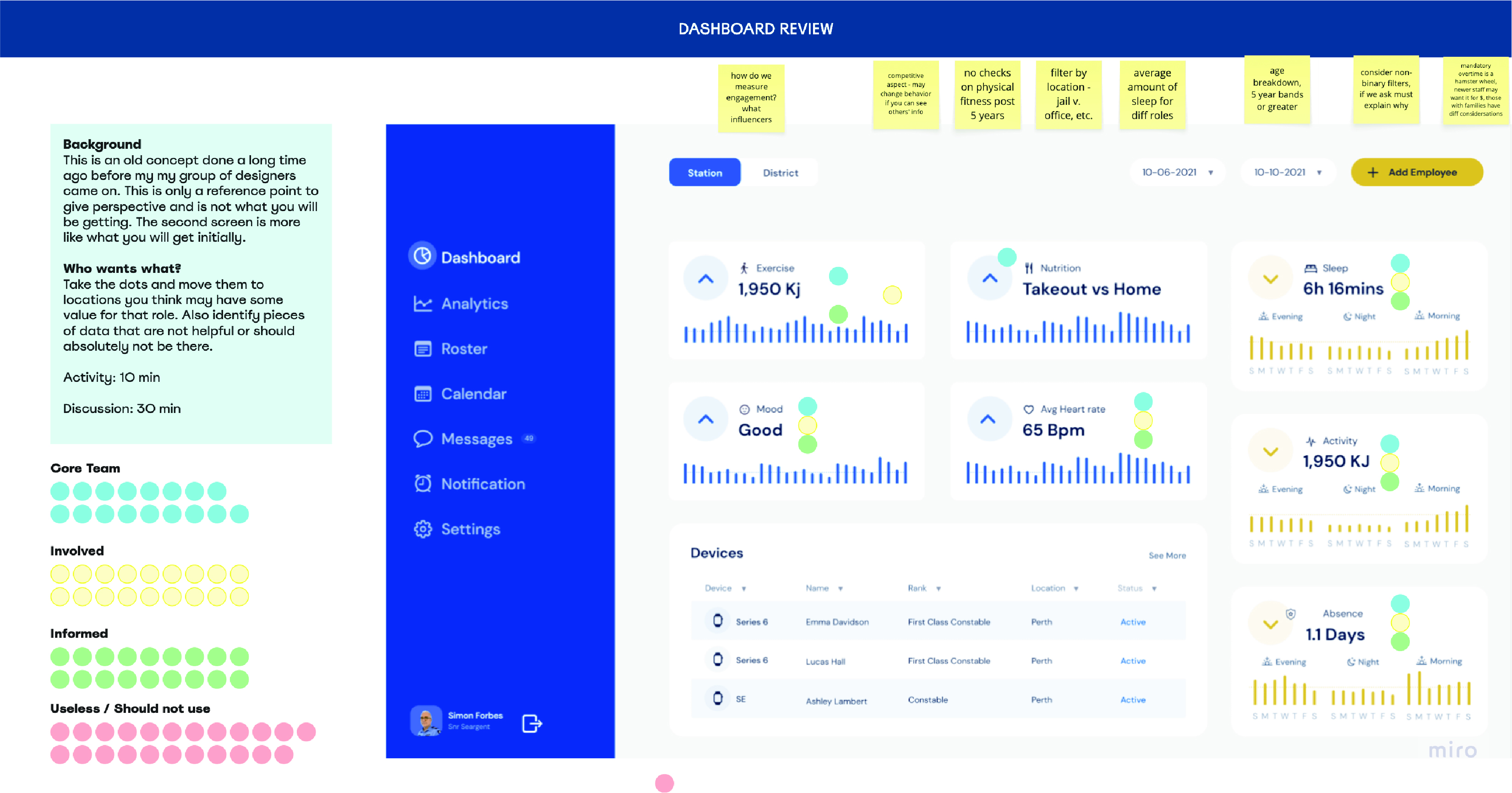
The final exercise in the series used an existing reference dashboard concept, built earlier by a different design group and shown purely as a conversation prompt, to ground an otherwise abstract discussion in something real. Participants sorted specific candidate data points, like sleep duration, mood trends, heart rate variability, and activity levels, into the same Core Team, Involved, and Informed buckets established earlier.
Alongside that sort, the team flagged considerations and gaps the reference dashboard had not accounted for. Some of the most useful feedback in the entire series showed up here. One note pointed out that fitness comparisons needed to account for age rather than applying one standard across every deputy regardless of tenure. Another pushed on how status information was displayed, suggesting that a simple yes or no toggle was not always the clearest way to represent something that was genuinely more nuanced than binary.
The actual working dashboard was built in Power BI, informed directly by this access model and this set of considerations, rather than by the reference mockup used to prompt the conversation.
Structured exercises
Obstacles identified
Access tiers defined
Deliverables handed to design and development
In a culture where asking for help can carry real professional weight, the design question was never really about dashboards. It was about whether people would trust the tool enough to be honest with it. Structuring the workshop series to move from individual reflection to group synthesis, and giving the team room to raise their own hard questions along the way, let a group of deputies and HR staff who already wanted this to work say exactly what they needed out loud.
That is what made the handoff to design and development possible. The user stories and permission levels they built from were not inferred from the outside. They were authored by the people who understood the stakes best, because they were the ones who would carry the consequences of getting it wrong and the hope of getting it right.


